


By the time you are weighing K3s and K8s for your workload, you probably already understand the technical nitty-gritty.
Both run the same Kubernetes API and schedule containers, manage rollouts, and heal failed pods. The hard part is standing in front of your team and defending the choice as a decision the business can live with.
There are three angles to that decision: what the distribution costs you to run, how much operational burden it places on your team, and what happens to the business if you pick wrong and have to change course later.
This guide provides a framework for making that call, starting with the shape of your workload, translating each constraint into a cost or a risk, and letting the distribution choice follow from that reasoning.
K3s vs K8s: How Do The Two Kubernetes Distributions Compare?
K8s, or upstream Kubernetes, is the full distribution: every component, every optional feature, and the complete ecosystem of operators and integrations built around it.
K3s, on the other hand, is a certified Kubernetes distribution from SUSE that ships as a single binary, with a lighter default footprint and several components either swapped for lighter alternatives or made optional. It passes the same conformance tests as upstream Kubernetes, so the APIs your workloads rely on are identical.
One design choice, a smaller and simpler footprint, drives almost everything downstream:
- Less to install and less to keep patched, which shrinks the operational surface your team maintains.
- Fewer moving parts, which lowers the expertise required to run the cluster safely day to day.
- A narrower default scope, which suits constrained hardware, edge locations, and smaller clusters.
The nuances between the two distributions resolve into one of three business terms: cost, risk, or operational burden.
But which of them is the right choice for your workload?
The three questions the distribution choice answers
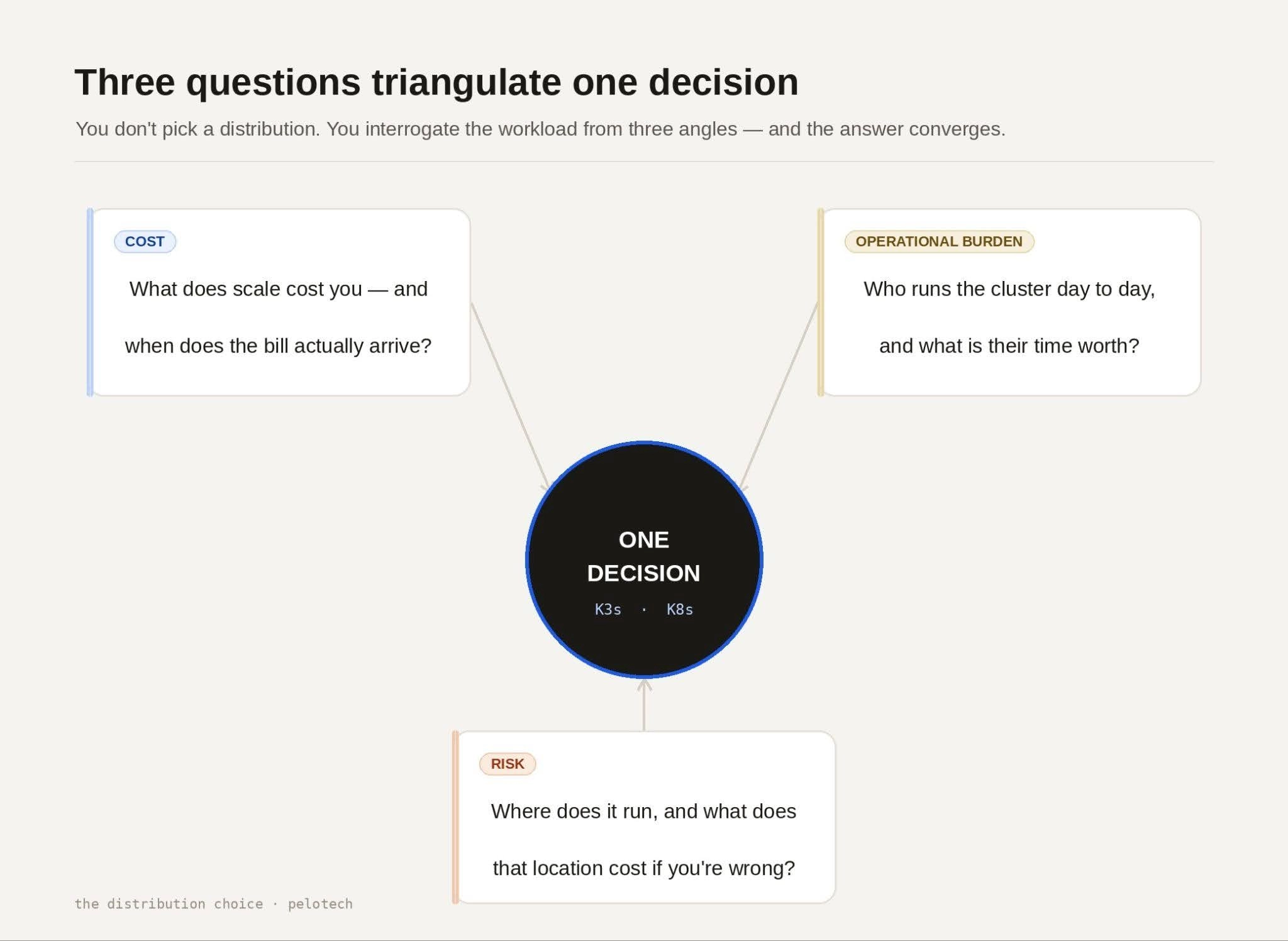
- What does scale cost you?
There are three key inputs that help shape the answer to that question: node count, whether you need a highly available control plane, and how much multi-tenancy the cluster has to support.
K3s runs happily on a single node and supports multi-server high availability through embedded etcd or an external database, though that setup rewards deliberate planning.
On the other hand, Full and managed K8s is built for large node counts and heavy multi-tenant control-plane demand as a baseline.
Paying for headroom you may never use is a cost today, but a forced re-platform under load is a larger cost later, plus the disruption that comes with it. Estimate your realistic 18-month node count and control-plane demand, then decide which of those two costs you would rather carry.
- Who absorbs the operational burden?
Talking operations, we need to consider the maintenance surface, upgrade cadence, and on-call reality of running the cluster yourself.
Lightweight distributions consistently find K3s simpler to install, update, and operate, which lowers day-to-day overhead. On the flip side, Full K8s carries a steeper learning curve and a broader set of components to keep healthy. Managed services such as EKS, GKE, and AKS remove control-plane management for you at a recurring price.
In other words, self-managed full K8s spends those hours on cluster upkeep, while K3s spends fewer of them. A managed service converts that time into a predictable monthly bill. The right answer depends on whether your scarce resource is cash or senior engineering time.
- Where the cluster runs
In constrained-hardware testbeds, K3s used the least CPU, memory, and disk of the distributions measured, and it is purpose-built for edge and IoT. Conversely, full K8s suits large, resource-rich, centrally hosted clusters.
At the edge, on small or intermittent hardware, K3s becomes the economically obvious answer, and the savings against a cloud-only full K8s deployment can be substantial. For a workload living in one central cloud region at scale, that edge advantage disappears, and the scale and burden questions take over.
The choice between K3s and K8s depends on your workload
The best approach here is to make a decision based on the shape of your workload:
Treat these as starting points. A regulated workload that happens to be small may still run well on hardened K3s. Also, a single-team platform with a credible path to heavy multi-tenancy inside a year may be worth building on full K8s from the start. The framework tells you which way the evidence leans and where to look harder before committing.
K3s vs K8s: the cost of choosing the wrong distribution
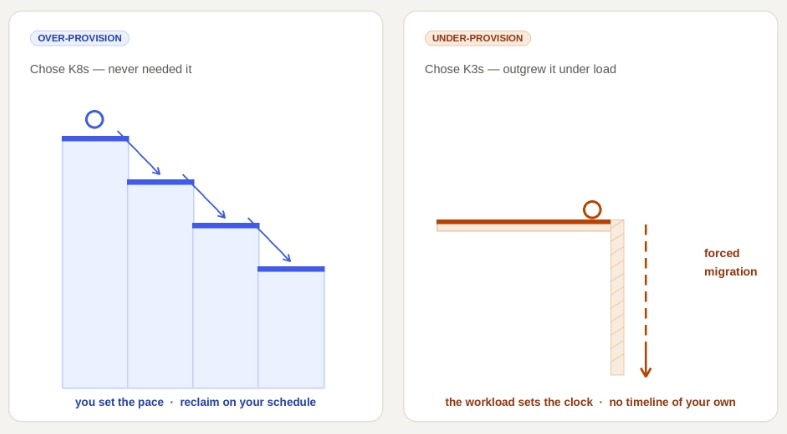
Over-provisioning: paying for K8s you never needed
Choosing full K8s for a workload that never demanded it means carrying complexity and spending with nothing to show for it. The costs surface as:
- Senior engineering hours spent maintaining a control plane the workload never stresses.
- Higher resource consumption on your hardware, or a larger managed-service bill.
- Slower delivery, because every change has to move through more machinery.
Practitioners frequently describe full K8s as overkill for small teams, with many reporting K3s running stably in production at small-to-medium scale. Recovery from this mistake is usually gradual and inexpensive: you simplify, or you migrate down once you notice the waste, on a timeline you control.
Under-provisioning: hitting a wall on K3s
Choosing K3s for a workload that later outgrows it produces the wall-hitting scenario practitioners worry about out loud. The real cost lands in the unplanned migration under load, on a timeline the workload chooses for you, while the cluster is already business-critical. Teams evaluating K3s for production raise this exact anxiety repeatedly: will it hold at scale, or will we be forced to rebuild later.
The two mistakes are lopsided, and that lopsidedness should shape your cautious default.
- Over-provisioning wastes money you can reclaim on a schedule you control.
- Under-provisioning risks a forced migration on a schedule the workload controls.
For workloads with a credible path to heavy scale, the safer error leans toward over-provisioning. For workloads that are stable, small, or at the edge, the safer error leans toward staying lean on K3s. Name which situation is yours, and you have named your safer default.
Start with the Right Workload Diagnosis Before Committing
Choosing between K3s and K8s must be based on proper diagnosis of your workload.
Pelotech runs this strategic diagnosis as a Kubernetes Certified Service Provider, putting the senior engineers who will do the work on the call from the first conversation. When the stakes are high enough that a wrong call means a painful re-platform, a second opinion from people who have stood at this crossroads across dozens of clients is worth the conversation.
For example, one of our clients at Pelotech arrived certain they had a Kafka configuration problem to solve. Our engineers questioned whether Kafka should be in the architecture at all, diagnosed it as the wrong tool for the job, and removed it entirely, because sometimes the workload needs less infrastructure, and the honest recommendation is to run leaner.
We’ve also helped UKi move its infrastructure to the cloud. Midway through the engagement, two problems surfaced:
- a costly, unreliable dependency on a third-party virtualization platform provider was causing repeated work stoppages
- UKi was running all development and demos out of a single, manually-built, non-reproducible environment.
Pelotech's response was to build UKi its own virtualization platform from open-source components, KubeVirt for running VMs in Kubernetes, Kube-OVN and Multus for software-defined multi-network topologies (mimicking real enterprise networks for training scenarios), Apache Guacamole for browser-based VM access, and Helm for provisioning.
The team went from proof-of-concept in 2.5 months to MVP in 6 months, and also stood up multiple isolated environments so feature development no longer disrupted live customer use.
So, if the honest diagnosis is that K3s on your own hardware is everything you need, that is the answer you will get.
Conclusion
Choosing between K3s and K8s is a business decision with engineering inputs: what the distribution costs to run, how much operational burden it places on your team, and the asymmetric risk of the wrong pick.
Work the three questions, map them to the shape of your workload, and weigh which mistake is cheaper to recover from given your reality. Do that, and you walk into the room able to defend your choice with reasoning that a budget holder and an engineer can both follow. The discipline is to diagnose the workload first and reach for the tool second.
