

%20(1).webp)
Most Kubernetes consulting firms are impossible to tell apart from their websites. The certifications line up, the service menus line up, and every one of them promises production-grade clusters and round-the-clock support.
The things that decide whether an engagement actually works, who shows up to your calls, whether they diagnose before they build, whether the senior engineer you met is still there at go-live, don't appear on any service page.
We run Kubernetes engagements at Pelotech, and we also get hired to rebuild the ones that collapsed, usually after they went to whoever quoted the lowest day rate. Seeing both ends of that has made the real differences obvious, and none of them are certifications.
Four questions tell you what the credentials can't:
- Will they diagnose before they prescribe, and say so plainly when Kubernetes is the wrong tool for the job?
- Do you talk to the engineer who'll do the work, or a salesperson relaying answers from one?
- Does that same engineer stay from the first call through go-live, or disappear once you've signed?
- Can they name a business result they changed, not just a cluster they shipped?
No single firm wins for every team, so the list below pairs each one with the work it's built for:
- Pelotech: Best overall for outcome-driven, embedded Kubernetes engineering
- Fairwinds: Best for governance, security, and managed EKS on AWS
- InfraCloud: Best for broad cloud-native adoption with deep CNCF expertise
- THNKBIG: Best for Kubernetes cost reduction and cloud modernization in the US
- Container Solutions: Best for enterprise cloud-native transformation at enterprise scale
- Dysnix: Best for high-load, latency-sensitive Kubernetes in fintech and SaaS
1. Pelotech – Best overall for outcome-driven, embedded Kubernetes engineering
Pelotech is a US-based Kubernetes consultancy with a deliberately small, senior team. Every engineer is CKA-certified and US-based, and they work inside your team rather than behind an account manager. We hold KCSP status, and we've shipped production Kubernetes on EKS, AKS, GKE, and bare metal for companies from early-stage SaaS through FedRAMP-bound, government-adjacent platforms.
We don't push a single stack. We dig into your clusters, workloads, spend, and how your team runs day to day, then recommend what the evidence points to, not what we'd rather sell you. Sometimes what we find is that the thing you came asking for isn't the thing you need, and hearing that before the build costs a lot less than hearing it after.
Core services
- Infrastructure assessment: A root-cause read on your cluster topology, workloads, and cost structure before anyone recommends a build.
- Production Kubernetes builds: EKS, AKS, GKE, and on-prem, designed for the reliability and scale your workloads actually need.
- GitOps implementation: ArgoCD and Helm pipelines so deployments are version-controlled, auditable, and safe to roll back.
- Cloud migration: Legacy-to-Kubernetes moves with documented cost and performance targets, not open-ended timelines.
- Cost optimization: Right-sizing, dependency removal, and FinOps work that shows up on the cloud bill.
- Enablement: Documentation, runbooks, and knowledge transfer so your team owns the platform after go-live instead of renting it from us.
When you work with Pelotech, here’s what happens:
You meet the engineer, not a sales team
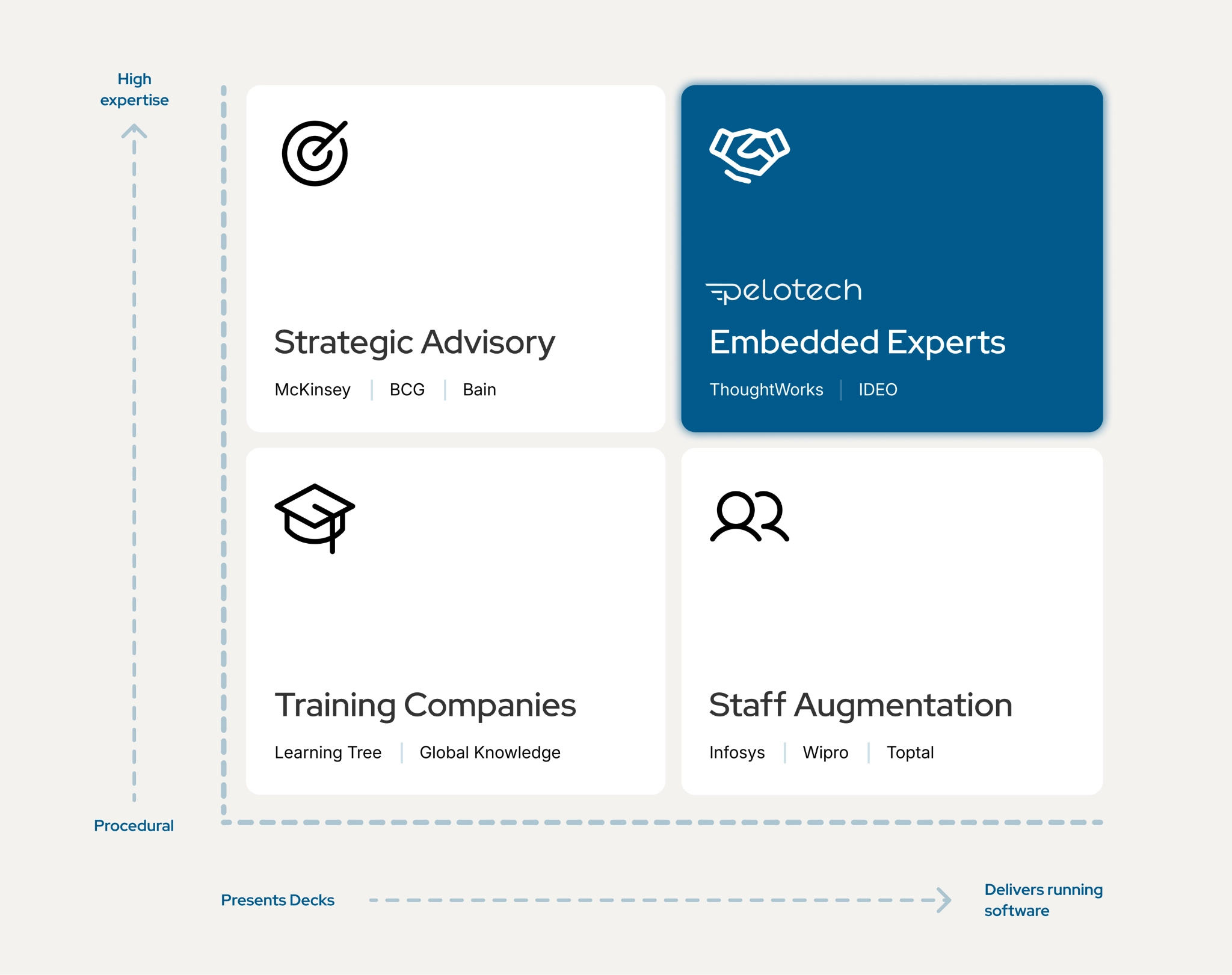
Most firms put a senior architect on the sales call to win the deal, then route the actual build to a junior team or an offshore shop. You never see the architect again. We don't split it that way: the engineer who picks apart your architecture on the first call is the one who owns the delivery.
On that call, instead of a capabilities pitch, you get an engineer poking at your setup, questioning decisions, and naming risks before there's a contract, up to and including telling you Kubernetes is the wrong tool for the job. Most firms won't say that, because they only get paid if you build.
UKi Case Study: From unstable infrastructure to compliant, fast-deploying platforms
When UKi engaged Pelotech, OD360, their core platform, was fragile and overbuilt. Thirty to forty interdependent services with no self-healing. Standing up in a new environment required three to four people working for four weeks or more. Production deployments happened once every six months to a year. And when something broke in production, the team was flying blind: no logging and no change history to trace what had gone wrong.
Pelotech refactored OD360 at the application level, applied the Pelotech Foundation Stack (multi-account AWS Organizations, identity federation, EKS managed with ArgoCD GitOps, and full security automation), and extended the Kubernetes stack to support GovCloud ATO requirements. The measured results:
- $500k in annual savings
- 97% reduction in deployment time
- 3x improvement in availability
- A role in achieving FedRAMP certification
Numbers tell one side of the story. Here's what the client had to say:
Where Pelotech isn't the right fit
We’re the wrong call if:
- You need a large bench spun up across regions in a hurry. We stay small and senior by design, so that isn't us.
- Your decision comes down to the lowest hourly rate. Ours isn't the lowest, though the gap tends to close once you price in the cleanup a cheap build leaves behind.
- You want the brief built as written, no questions, no assessment first. We'll push back when the plan is wrong.
2. Fairwinds – Best for governance, security, and managed EKS on AWS
Fairwinds comes at Kubernetes from the platform side. Their own tool, Fairwinds Insights, handles RBAC auditing, policy-as-code, right-sizing, and security guardrails, and the whole consulting practice is built around it. The open-source projects they maintain (Polaris, Goldilocks, Pluto) run in clusters across the community, a sign their engineers have thought hard about where clusters drift and break.
Where most firms treat governance as a bolt-on phase, Fairwinds bakes it in from the start, so regulated teams facing an audit avoid the painful retrofit of adding controls after everything is already built.
In early 2026, Fairwinds signed a strategic collaboration agreement with AWS to deliver fully managed Kubernetes on Amazon EKS. For teams already operating in the AWS ecosystem, that means one partner can own managed operations end-to-end on your existing infrastructure.
Core services
- Governance-first delivery: Policy-as-code, RBAC auditing, and compliance guardrails shipped by default, not retrofitted.
- Managed EKS on AWS: A formal AWS partnership backing fully managed Kubernetes for teams committed to Amazon's stack.
- Fairwinds Insights: Their own governance platform for cluster health, cost visibility, and drift detection.
- Open-source tooling: Polaris, Goldilocks, and Pluto, widely used across the community for right-sizing and deprecation checks.
Where Fairwinds isn’t the right fit
- Teams running primarily on GKE or AKS may find the AWS-first orientation a constraint.
- The tooling-led model fits established workloads that need optimization and governance layered on top. It's a weaker match for greenfield platform engineering, or for the root-cause work required when the underlying architecture is the actual problem.
Before signing, ask how much of the value depends on staying inside their tooling and AWS, and what the engagement looks like if you later move workloads to another cloud.
3. InfraCloud – Best for broad cloud-native adoption with deep CNCF expertise
InfraCloud runs big, with a bench of 100+ engineers and clients across automotive, banking, and SaaS. A merger with the digital-services firm Improving extended its footprint into the US, Canada, Latin America, and India. Its edge is range across the whole cloud-native stack: not Kubernetes in isolation but the service meshes, observability, and security tooling wrapped around it, and deep involvement in the CNCF projects that underpin all of it.
For teams standardizing on the CNCF ecosystem, that community involvement translates into practical consulting quality. Engineers who contribute to the projects they recommend have seen how the software fails, where the edge cases are, and which configurations break at scale, knowledge you don't get from reading the docs.
Core services
- Full cloud-native scope: Service mesh, observability, security, and CI/CD delivered alongside core Kubernetes, from one team.
- CNCF depth: Active contributors to Argo, Flux, Cilium, and related projects, with hands-on knowledge of their edge cases.
- Platform engineering: Internal developer platforms and paved-road tooling for teams standardizing how they ship.
- AI infrastructure: GPU scheduling and ML-workload support for teams moving models into production.
Where InfraCloud isn’t the right fit
- If you want a lean, senior-only pair on one focused problem, InfraCloud's scale is more than the job needs. Their sweet spot is a broad cloud-native transformation, not a single-cluster tune-up.
- With a team that large, the person who pitches you on the call may not be the one assigned to your build.
Before signing, ask for the specific engineer, their track record, and whether your project has them full-time or shares them across three other accounts.
4. THNKBIG – Best for Kubernetes cost reduction and cloud modernization in the US
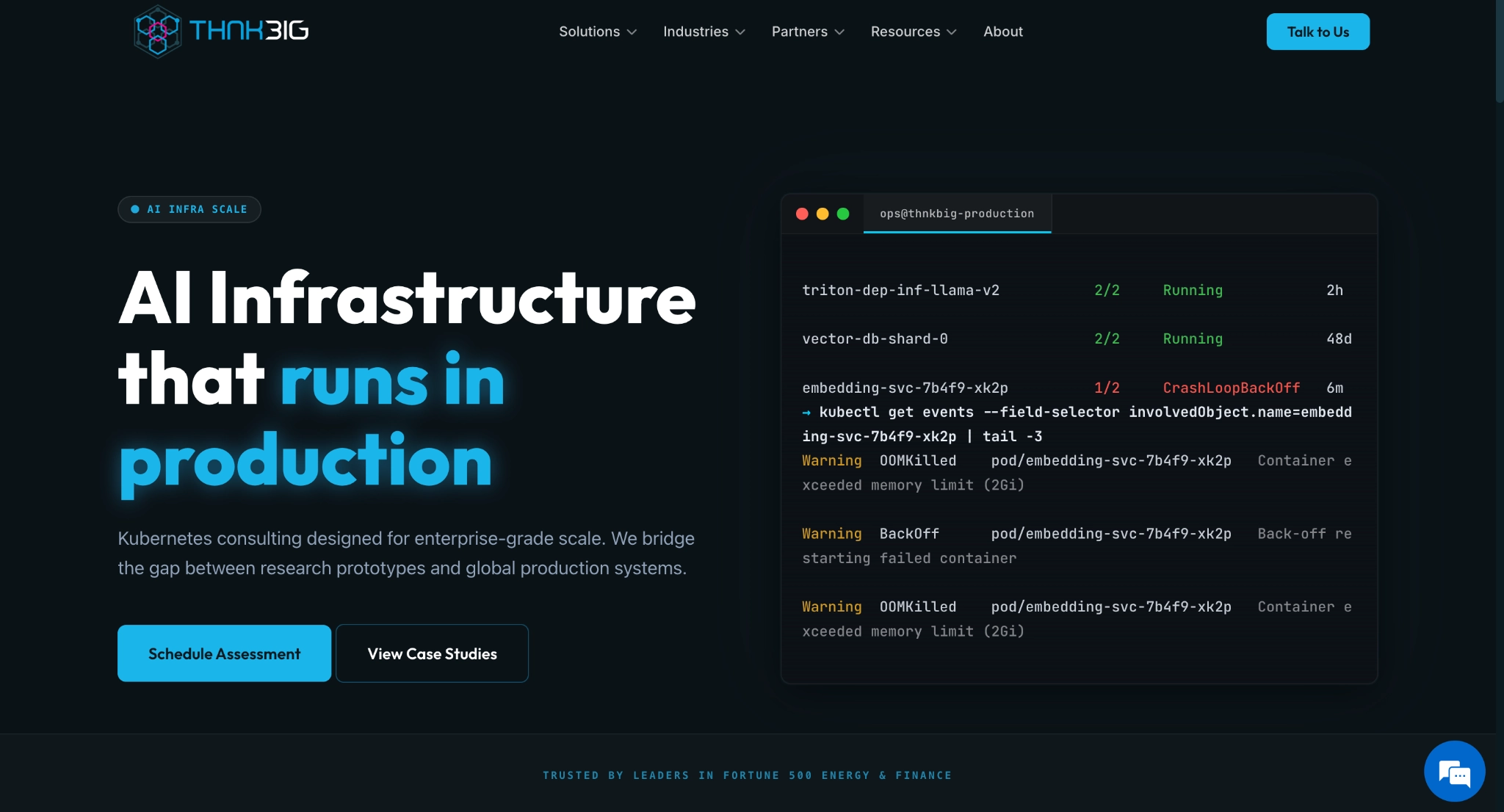
THNKBIG sells one outcome above all others: a smaller cloud bill. The US-based consultancy and CNCF Silver Member reports cutting infrastructure costs 40 to 60% on average, and staffs senior engineers only, with no junior handoff layer. That last part is the same bet we make at Pelotech, which is why they're worth taking seriously.
Because cost shapes the engagement from day one rather than the final report, teams justifying Kubernetes spend to a CFO or board get architecture decisions and success metrics oriented around the number they'll be asked about.
Core services
- Cost reduction as the headline: 40 to 60% infrastructure savings via right-sizing, spot instances, and killing idle resources.
- Senior-only, US-based team: No junior handoffs, all work done by 10+ year engineers.
- Regulated-industry compliance: Documented FedRAMP, HIPAA, and PCI-DSS engagements, plus IL-4/IL-5 for defense.
- CNCF Silver Member: Active in the ecosystem, contributing to Kubernetes, ArgoCD, and Prometheus.
Where THNKBIG isn’t the right fit
- Public case-study depth is thin compared to others here. Their material leans on outcome percentages more than named clients you can call.
- If your main need is compliance, governance, or organizational change rather than cost, you'll find a better fit elsewhere.
Before signing, ask for a named reference at your scale and cloud, and ask how the cost-reduction number was measured: before and after, on which line items.
5. Container Solutions – Best for cloud-native transformation at enterprise scale
Container Solutions leads with strategy, treating organizational and cultural change as part of the technical delivery rather than a separate exercise. In a large enterprise, the hard part is organizational: a dozen teams sharing one platform with no agreement on how to run it.
Their published case work includes enterprise-scale GitOps designed to balance team autonomy with security and compliance. Surfacing that structural friction alongside the infrastructure problems is what makes the delivery durable rather than a platform nobody adopts.
Core services
- Transformation strategy: Cloud-native roadmaps that sequence risk reduction and early value ahead of full rollout.
- Organizational change: Delivery that treats team structure and ways of working as part of the engineering problem.
- Enterprise GitOps at scale: CI/CD and delivery models built for many teams sharing one platform safely.
- Platform engineering advisory: Toolchain selection, governance, and delivery-model design for large orgs.
Where Container Solutions isn’t the right fit
- If you need a fast, tactical fix or a lean embedded partner, the scope is too broad, and the model is slow. This is a firm for multi-quarter, executive-sponsored transformations, not a cluster resolved by the next sprint.
Before signing, be honest about whether you have the executive mandate a transformation assumes. Without it, the work stalls no matter how good the partner is.
6. Dysnix – Best for high-load, latency-sensitive Kubernetes in fintech and SaaS
Dysnix built its name on the workloads where a performance failure isn't something you recover from: high-load, latency-sensitive production traffic. They embed senior DevOps engineers. And their own autoscaling tool, PredictKube, targets one of the most common ways high-scale Kubernetes falls over: autoscalers that react too slowly to a sudden traffic spike.
PredictKube isn't a rebranded horizontal pod autoscaler but a purpose-built tool for workloads where reactive scaling is always too late. For fintech and blockchain teams where a 30-second scaling lag means dropped transactions or settlement failures, that's a distinction most general-purpose consultancies can't address. And for a firm their size, the track record behind it is unusually well-documented.
Core services
- PredictKube: AI-driven predictive autoscaling that provisions ahead of traffic spikes instead of reacting to them.
- High-load specialization: Cluster design and performance tuning targeting sub-50ms response times under volatile load.
- Embedded senior DevOps: A boutique, senior-only model where one engineer owns your uptime rather than a black-box team.
- Web3 and fintech track record: 100+ projects and $20M+ in reported client savings, with clients like PancakeSwap.
Where Dysnix isn’t the right fit
- The specialization cuts both ways. They're strongest for fintech, blockchain, and high-scale SaaS, and a weaker fit for healthcare, EdTech, or regulated government, where compliance and governance matter more than raw throughput.
Before signing, ask for a reference in your specific industry, since their strongest proof clusters in Web3 and fintech and may not map to your world.
How we evaluated these Kubernetes consulting services
A "best of" list built on certification count or marketing spend tells you nothing, because Kubernetes consulting isn't commoditized. The same KCSP badge and the same "end-to-end" menu sit on the sites of firms that send senior engineers and firms that don't. Here's what pulls them apart and how to check each one for yourself.
Do they diagnose or just prescribe?
Watch what a firm does before it recommends anything. If a proposed architecture lands before anyone has looked at your clusters, your pipeline, your team's skill mix, or where your spend is actually going, you're buying a template, not a diagnosis.
The tell of a serious firm is a real assessment window written into the engagement before you sign, and the nerve to come back with the inconvenient answer: that Kubernetes is overkill for you, or that the problem sits a layer above the infrastructure entirely.
Multi-cloud is the classic example. It sounds like insurance, but it usually just buys you a complexity tax you didn't need. Here's our take on when to say no to it:
[Don't do multi-cloud Kubernetes until you can answer this question.]
Are they neutral, or selling one stack?
A shop whose revenue rides on one platform or one managed offering will not tell you the cheaper, simpler path is the right one, even when it is. So check.
Ask what they've run in production and, more revealing, what they've talked clients out of. A firm that can point to work it walked away from, because the honest call was your existing setup, a managed service, or a fix that wasn't infrastructure at all, is one whose recommendation carries weight.
Who's actually on the call?
Put a salesperson between you and the engineers, and you lose twice. The detail that should shape the whole build gets sanded down before it reaches anyone who could act on it, and you forfeit your one chance to size up the engineers themselves: how they reason, what they've broken before, whether they've met your problem.
That read is the most useful thing a first call can give you. Watch, too, for the architect who turns up to charm the sales call and is never seen again once you've signed. Whoever learns your situation in that room should be the one who builds.
Seniority over headcount
Anyone can get a cluster running. Keeping it healthy under real load is where it comes apart, and the ways it comes apart don't show up in a tutorial: an RBAC policy that grants more access than anyone noticed, resource limits that trigger OOM kills at peak, a network policy that strands traffic, autoscaling that can't keep up when traffic spikes. Engineers learn those by having been on call when they happened.
An engineer who's seen your particular failure before fixes in an afternoon what a junior chases for two weeks, then hands to a senior to redo anyway. Headcount works against you here: every extra pair of hands is another handoff and another gap in the documentation. A small, senior team leaves behind infrastructure your own people can understand and run.
How to run a discovery call that actually tells you the truth
"Who runs this engagement from discovery to go-live?"
Listen for a named, senior engineer with a defined role, not "our team." The answer tells you whether there's a handoff to an offshore execution layer after the sales call closes.
"Tell me about a project where you advised a client not to use Kubernetes."
Hesitation, a pivot back to capabilities, or no concrete answer signals a firm that sells Kubernetes regardless of fit. A diagnostic-first team answers this without prompting.
"How do you handle a situation where the original architecture turns out to be wrong six weeks in?"
Listen for a process, not just reassurance. The right answer describes how the assessment phase catches those problems early and what happens when it doesn't.
"Walk me through how you define success for an engagement like ours."
Generic output metrics ("delivered cluster," "completed migration") tell you what they'll ship. Business outcome metrics (deployment frequency, uptime, cost reduction, team capability) tell you what they're actually accountable for.
"What does post-go-live support look like?"
The answer should describe documentation that explains why decisions were made, not just what was configured, and ongoing access to the engineers who built the setup, not just a support ticket queue.
"Can you reference a project similar to ours, same scale, same cloud, same compliance requirements?"
Reference quality matters more than reference existence. A reference in a different industry at a different scale doesn't tell you much about how they'd handle your situation.
Conclusion
The wrong Kubernetes partner doesn't announce itself on day one. It shows up months later, in a cluster your team can't maintain, a bill nobody can explain, and a rebuild you end up paying for twice. The six questions above surface that risk while it's still cheap to walk away.
That kind of honest diagnosis is where we start, too. Every Pelotech engagement opens with a free assessment of what your infrastructure needs, before anyone talks scope or price. There's no obligation, and if Kubernetes turns out to be the wrong call for you, we'll say so instead of selling you a build.
