


Shortlisting Argo CD consulting service providers can be tough. Sorting through a dozen tabs, requesting suggestions from others in the industry, and checking out service pages only yields a shortlist with the same framing: certified experts, GitOps best practices, and 24/7 support.
Our team at Pelotech goes through many tooling decisions with teams, implementing GitOps and various CI/CD pipelines (including Argo CD), and therefore have a good idea of the markers that distinguish the best vendors from the rest. As such, we've created a list of the top 6 Argo CD providers, depending on whether they:
- Assess your team and infrastructure setup before recommending anything.
- Suggest the best-fit CI/CD tool, even if it's not Argo CD, and accept the risk of losing the engagement.
- Feature engineers on sales calls, rather than salespeople reading out suggestions.
- Include senior engineers on every deployment.
Based on that criteria, The top ArgoCD consulting service providers we’ve reviewed include:
- Pelotech
- PSNS
- Akuity
- InfraCloud
- MeteorOps
- AppsCode
1. Pelotech
Best fit: Companies looking for expert-level guidance to determine the best setup for their specific needs.
.webp)
Pelotech is a U.S. based software engineering consultancy staffed by senior engineers with years of experience in Kubernetes, cloud infrastructure, AWS, and software development. They're a Kubernetes Certified Service Provider, and have delivered GitOps implementations using both Argo CD and Flux across industries, from SaaS scale-ups to regulated, government-adjacent platforms.
This broad experience grants us a deep understanding of the best way to approach CI/CD deployments to ensure they work and don’t incur unnecessary cloud costs. That’s why, instead of handing the work to junior engineers, freelancers, or contract staff in a different time zone, Pelotech's senior engineers work directly with your team as partners.
Before you even sign a contract, these engineers, alongside our leadership team, will assess your cluster topology, existing CI/CD pipeline, and deployment processes. The results of the assessment determine the next step. That way, we are truly giving you a solution that fits your exact needs, rather than simply proposing one that costs you more to fix later or eats into your cloud budget.
Thanks to this approach, we’ve helped companies reduce their annual cloud costs by $500,000 and deliver projects 8x faster than initial projections.
Here’s what you get when you hire Pelotech:
Get an honest tool recommendation before committing to Argo CD
Some vendors on this list specialise in Argo CD. That means their recommendation starts and ends with Argo CD, regardless of whether it's the right fit for your team.
Conversely, we've worked across the CI/CD landscape in production (Argo CD, Flux, and the broader tooling around them), so our recommendation is shaped by what we've seen work, not what we specialise in selling. In some cases, we've told clients who came to us that Argo CD wasn't the right call because their team was engineering-led, Git-native, and didn't need a dashboard that nobody would open.
One of our engagements started as an Argo CD implementation request. During the assessment, our engineers found that the real cost driver wasn't the deployment tool but the underlying cluster configuration. Fixing that cut more than $500,000 from the client's annual cloud spend.
Speak to the person doing the work, starting from the first call
At Pelotech, the engineer you speak to during the onboarding call is the same person who'll lead your engagement. This is a deliberate decision we took to ensure that context isn't lost, and that engineers hear the nuance they need first-hand for the entire engagement.
For you, that also means the discovery call is already a working session. Our engineers will ask about your sync policies, challenge your assumptions about cluster topology, and flag potential issues before a contract is signed.
By the time the engagement starts, the person doing the work already has full context on your setup, your constraints, and the real problems. That way, work begins right away, since the engineer doesn’t need a ramp-up period to catch up on what was discussed during the sales call, and no knowledge is lost in translation.
Catch the wrong plan before it becomes an expensive rebuild
Aug teams typically adhere to every detail contained in the brief, even if it may not seem like the right choice. It’s how you end up with a temporary fix that becomes a costly issue later, or a situation where your engineers spend more time fixing deployments than writing code.
To avoid this, we treat client requests as a starting point. Our engineers, who are well-versed in every scenario and failure mode, first assess your current setup, question the brief, and then suggest the best deployment strategy.
Due to this operating model, we've had engagements where the client asked for an Argo CD implementation, and the real problem turned out to be pipeline design. And we've walked away from lucrative projects because the honest answer was that the client didn't need what they were asking us to build. Instead, we suggested a permanent solution to the issue they identified.
Granted, the push-back is uncomfortable in the moment. But it's cheaper than the alternative. Building the wrong thing on time and on budget isn’t economical, as the subsequent rebuild always costs more than the original engagement.
Access senior support available long after you go-live
Most consulting engagements end the moment the invoice is paid, leaving your team to inherit a production system they didn't design. That's not how our engagements typically work. Some of our client relationships started with a focused project and grew into ongoing advisory partnerships. And during the engagement, we transfer knowledge as we go through:
- Documentation that explains why things were built the way they were, not just what was configured.
- Runbooks for the scenarios your team will actually face: failed syncs, new application onboarding, secret rotation, and drift detection.
The goal is to make your team self-sufficient for day-to-day operations. For situations your team can’t solve on its own (such as a critical CVE in Argo CD or a major version upgrade that changes how ApplicationSets are handled), the engineers who built your setup are always available.
Where Pelotech isn’t the right fit
Pelotech might not be the best fit for you if you:
- Don’t need help with diagnosis and have already decided on an architecture setup.
- Are comparing against offshore staff augmentation. Hiring a consultant with senior engineers might seem steep, but as you may later find, the cost of a deployment that doesn’t work or consumes your cloud budget is far higher.
- Want a team that executes without questioning the brief or doing a prior assessment to confirm what you actually need.
Pricing
- Not publicly available. Will be decided after confirming what you actually need.
2. PSNS
Best fit: Teams looking for a consulting firm with breadth across the Kubernetes and CI/CD landscape.
PSNS is an infrastructure engineering consultancy founded in 2021, with offices in Amsterdam and New Delhi. Their founding team includes engineers who built internal cloud platforms at Flipkart, one of India's largest e-commerce companies. Recognisable brands such as Booking.com, Nike, and Yahoo are part of the customers.
Most importantly, their service offering extends beyond Argo CD.
PSNS offers platform engineering, Kubernetes consulting, SRE, observability, cloud migration, security audits, and database administration. On the CI/CD side specifically, they work with Argo CD, Flux, Helm, Kustomize, Werf, Terragrunt, and Terraform. That breadth grants them the ability to suggest the right deployment tool.
That said, PSNS has offices in Amsterdam and New Delhi. A split team across time zones can delay responses, especially when you need assistance quickly. Plus, that could indicate an operating model where junior engineers handle projects under the supervision of seniors.
So, you should inquire who specifically would be on your engagement, where they're based, and whether the same engineers are on the project from start to finish.
Pricing
- Their pricing isn’t publicly available.
3. Akuity
Best fit: Teams that have already committed to Argo CD and want the deepest possible expertise on that specific tool.
Akuity is a product company with a consulting arm. They were founded by Hong Wang, the original creator of the Argo project, and include active Argo CD maintainers who still contribute to the open-source project today.
For you, that means working with Akuity gives you direct access to the engineers who built Argo CD. When a critical bug surfaces or a major version introduces breaking changes, their team doesn't need to research the issue since they wrote the code. That access is backed by a mission-critical SLA with 24/7 support.
However, such first-hand understanding of the Argo CD infrastructure is also a weakness.
If your deployment challenges happen to involve pipeline design, team structure, infrastructure outside of Argo CD, or a situation where Flux or another tool would be a better fit, that falls outside their scope. They are the best fit only if you've already committed to Argo CD and your priority is depth of expertise with that specific tool.
Pricing
- Pricing for their consulting services isn’t publicly available.
4. InfraCloud
Best fit: Large enterprises whose projects require 15 or 20 engineers working simultaneously across multiple workstreams.
InfraCloud is one of the largest Kubernetes-focused consulting firms on this list, with 170 in-house engineers and over 100 clients across industries such as automotive, banking, and SaaS. Thanks to their recent merger with Improving (a global digital services company), they have extended their footprint across the US, Canada, Latin America, and India.
What stands out is the breadth. Argo CD is one of many services offered by the company, which also includes Kubernetes consulting, Jenkins, CI/CD pipeline design, and platform engineering.
On the Argo CD side specifically, the service covers landscape assessment, GitOps pattern configuration, multi-tenancy setup, RBAC, SSO integration (OIDC, OAuth2, LDAP, SAML 2.0), high availability, and post-implementation training. Managed Kubernetes services and enterprise Argo CD support are available for teams that need ongoing operations coverage after the initial implementation.
That said, with 170 engineers on the bench, the person you speak to on a discovery call may not be the person who ends up on your project. So, before signing the contract, ask who specifically would be assigned, what their seniority level is, and whether they'll be dedicated to your engagement or splitting time across clients.
Pricing
- It’s not publicly listed.
5. MeteorOps
Best fit: Teams that need DevOps help but aren't sure whether they need a strategic partner or an extra pair of hands
MeteorOps is a DevOps professional services firm delivering consulting, solutions outsourcing, staff augmentation, on-call support, and ongoing infrastructure support. Their clients include big names such as Wise Commerce, Unity, and Erisyon.
What sets them apart from the other companies on this list is that, is that unlike most companies that focus on either consulting, outsourcing, or staff augmentation, they offer both and let you choose. Such transparency is uncommon in a space where some vendors disguise outsourcing or staff augmentation as consulting services, and vice versa.
That means, you can pick the engagement format that best aligns with your needs:
- Consulting services for teams that need help figuring out what to build before building it.
- Staff augmentation for teams that have already diagnosed the problem and just need an experienced engineer to execute a defined plan.
- Outsourcing for teams with a clear project in mind who want MeteorOps to own the planning and delivery, not just provide DevOps engineers.
If you’re not sure of what you need, MeteorOps lets you start with one model and shift to the other as the engagement evolves, so you're not locked into a contract you never needed.
Either way, you still get complete assistance. If you book a consulting engagement, you get an assessment, a strategy, and hands-on implementation. However, if you’re an enterprise in need of staff augmentation alongside Argo CD services, they provide a pre-vetted DevOps engineer to execute your plan.
Argo CD, one of their key service pillars, includes repository and RBAC configuration, CI/CD integration, and day-2 runbooks. And if Argo CD doesn't fit your needs, they can also set up Flux CD as your CI/CD system.
One important note, however, is that they describe "pre-vetted DevOps Engineers" but don't publish team size, individual engineer profiles, or seniority levels. With five different engagement models and a bench of engineers, it's unclear whether the same person stays on your project from start to finish.
Pricing
- Pricing isn’t publicly available.
6. AppsCode
Best fit: Enterprise teams running Kubernetes at scale who want a partner with deep platform-level knowledge, not just implementation experience.
AppsCode is a Kubernetes product company that also offers consulting services. They build and maintain open-source tools like KubeDB (managed databases on Kubernetes), Voyager (ingress controller), KubeStash (backup), and KubeVault (secrets management).
Such a strong product development background gives their engineers a deep understanding of how Kubernetes works, including advanced aspects such as building database operators and ingress controllers. This expertise has helped the company deliver 500 projects and 10,000+ deployments across clients, including Course Hero, Emerson, Enterprise Products Partners, and Nokia.
Their Argo CD service covers aspects such as ecosystem assessment, tailored architecture design, multi-cluster and hybrid environment deployment, and post-implementation training and managed support. And thanks to their GitOps consulting service, they help clients to audit existing CI/CD pipelines against GitOps best practices before recommending a tool or framework.
Where the product-plus-services model comes in handy is the depth it gives their engineers. For example, an engineer who has built a Kubernetes secrets management tool will approach your Vault and RBAC configuration differently than someone who has only configured what others have built. This ensures all architectural decisions are top quality.
One thing to keep in mind is that the primary CTA on their page suggests a sales layer between you and the technical team. You should clarify what their entire engagement will look like, whether engineers will be on calls, and if they include an initial assessment.
Pricing
- It’s not publicly available.
Decision Framework For Picking the Best ArgoCD Consulting Services
The six markers below are what we've learned actually predict a good engagement, drawn from sitting on both sides of these decisions. Some are features you’ll identify during your interaction with the engineering team, and others you can learn through research.
Head into meetings with a decision framework like this, to ensure you pick the best Argo CI/CD per your specific situation:
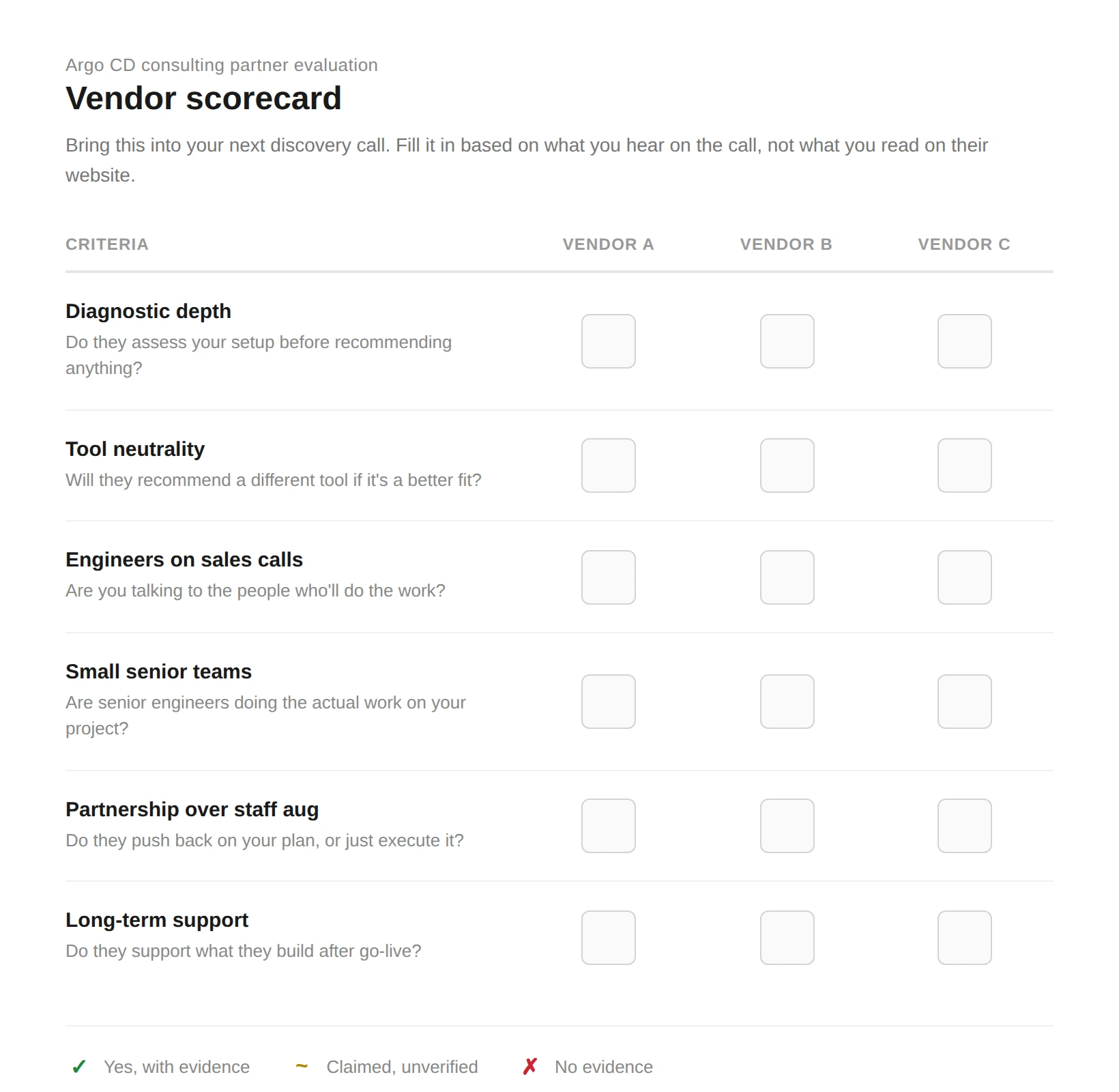
Here’s a deeper description of each criteria in the decision framework:
Diagnostic depth
The strongest predictor of poor engagement is a partner who shows up with the answer preloaded. Evaluation of your current state should precede any suggestion of a CI/CD option (such as Flux vs ArgoCD). If they're proposing Argo CD architecture before they understand your cluster topology, team skill mix, and existing CI, they're acting based on previous experience alone.
One way to find out how they approach projects is to check their website and pay attention to details in their proposal (or statement of work).
To demonstrate diagnostic depth, they should include a 1-2 week assessment period that audits your current pipeline, cluster setup, RBAC needs, and who deploys today before any contract is signed. You should be wary of vendors who go straight to suggesting the installation of Argo CD and configuring sync policies.
Another predictor of diagnostic depth is the breadth of the services they offer.
ArgoCD implementation is best handled by a company specialising in broader CI/CD pipeline development and DevOps practices. The company's experience with cloud-native environments and Kubernetes gives them a clear sense of the available options and helps them spot problems unrelated to the deployment tool itself.
Tool neutrality
A firm that only ships Argo CD has neither the incentive nor, often, the ability to tell you that Flux, a hybrid setup, or even your existing pipeline would serve you better.
This matters because installing the wrong tool results in months of rework, a team that never fully adopts the workflow, and a pipeline that runs counter to your org's culture. Not every team needs Argo CD, and not every pipeline problem is a tooling problem.
A genuinely neutral partner is willing to tell you that your current setup is fine and the real issue is process, team structure, or config management.
The first indicator of tool neutrality can be found on vendors’ service pages. What services do they offer? Is it limited to just one CI/CD framework? You could also request real-world examples of how they approach CI/CD assessment, especially the factors they consider when making decisions.
Engineers on every sales call
When a salesperson serves as the liaison between you and the engineering team, two things can go wrong.
First, the technical context gets flattened, and the nuance that should shape the entire engagement gets lost before it reaches the people who'd know what to do with it. Second, you lose the chance to evaluate the engineers themselves (their thinking, their instincts, and whether they've seen your kind of problem before), which is the single most valuable signal a discovery call can give you.
Who sits in the room during evaluation also tells you who you'll get during delivery. And for Argo CD work specifically, the discovery conversation serves as an architecture session that requires someone who's actually configured RBAC policies, debugged sync waves, and dealt with ApplicationSet sprawl in production.
Watch for the bait-and-switch version of this. A senior architect might join the sales call to earn your trust, and then you never see them again once the contract is signed. That’s not ideal, as the person who understands your context from the discovery conversation should lead the engagement.
Small senior teams
Argo CD is easy to install but hard to get right. Little mistakes could snowball into serious bottlenecks, especially when your application environment grows. And by then, it will already be too late to resolve, unless the entire infrastructure is rebuilt from scratch.
That’s why Argo CD setups are not a task for junior engineers abroad, who simply implement instructions. They won't catch that the repo structure doesn't match your team boundaries, that the sync policy will cause cascading failures under load, or that the ApplicationSet config will quietly duplicate resources when a new team onboards.
We've seen such situations play out and have been brought in to clean up some of them. Usually, although the original engagement was cheap, the junior engineers who had limited experience with Argo CD in production missed issues such as misconfigured RBAC or secrets committed to Git, which became expensive ones to fix six months later.
Beyond seniority, the size of the engineering team also matters.
Every person added to a team increases the odds of mistakes due to poor handoff or documentation. And although paying less for vendors staffed by junior engineers may seem economical, the cost of the total engagement usually says otherwise.
A senior engineer who has seen your failure mode before spends two days on what takes a junior two weeks, and the junior's work often needs to be redone once someone senior reviews it. This adds more hours and increases the total contract fee.
Partnership over staff augmentation
Staff augmentation is the default when a team needs help. It's cheaper than a full consulting engagement and fills your headcount gap. The problem is that staff augmentation only works if you've already diagnosed the problem correctly and just need hands to execute the plan. Otherwise, the contractor builds exactly what you asked for, on time and on budget, even if it’s not what you need.
A partner takes a different, but better approach. They treat your stated request as a starting point and then determine why your current CI/CD implementation is not working and what your team actually needs from a deployment tool. The answers they get then determine if Argo CD is the right call, or if there’s a deeper issue with pipeline design, team structure, or config management that no tool choice would fix.
However, staff augmentation can genuinely be what you need.
If your team has already done the architecture work, knows exactly what needs to be built, and just needs more hands for a defined window, a good contractor is the right call, and a full consulting engagement is overkill. The determining factor is whether you can write a clear, specific scope of work before the engagement starts. If you can, staff augmentation works; otherwise, you need a partner who assists with strategic direction.
Long-term infrastructure support
The initial Argo CD implementation is the first part. There are still version upgrades, CVE patching, drift that creeps back in despite your sync policies, RBAC changes every time the org restructures, and scaling decisions as your team or product grows.
Despite that, some consulting engagements end after the implementation is done and the invoice is paid. So, the team makes small changes to the Argo CD setup without fully understanding the original design decisions. Within a year, the setup causes more problems than it solves, and the next conversation is about ripping it out and starting over.
In practice, a vendor that provides long-term infrastructure support will:
- Create documentation explaining why things were built the way they were, and runbooks for the scenarios your team will actually face.
- Provide hands-on knowledge transfer during the engagement, rather than just dumping a bulky document on your team at the end.
- Provide ongoing access to the engineers who built the setup, in case there’s an issue down the line.
The scope of infrastructure support required of the consultants will largely depend on your team’s capabilities. If your team has the bandwidth and capability to handle future disruptions without stalling your product roadmap, then long-term infrastructure support doesn’t necessarily need to be included in the contract.
Conclusion
Every vendor on this list can install ArgoCD. The difference lies in what happens before and after the installation: whether they diagnose before prescribing, can tell you when Argo CD isn't the right fit, and provide support after implementation.
Take the six-criteria framework into your next discovery call. Ask about the diagnostic process, tool neutrality, who's on the call, who does the work, whether they push back, and what happens after go-live. The answers will separate your shortlist faster than any article can.
If you want to start with an honest assessment of what your team actually needs before committing to a tool or a vendor, that's how our engagements begin. But if you want a team that meets these criteria, book a free ArgoCD assessment consultation with our Kubernetes team.
