

Most AWS environments reach a point where running them eats into product work. EKS upgrades, IAM changes, Security Hub findings, patching, and incidents land on engineers hired to ship features, and the CTO becomes the escalation path because nobody formally owns the environment.
The best AWS managed service providers can take on that work, but they differ widely in how much they own. Some add 24/7 alert response next to an established platform team. Others run nearly the whole environment.
At Pelotech, our team of senior AWS engineers run AWS environments for companies that don't have dedicated cloud operations teams. For this guide, we compared eight AWS managed services providers, including Pelotech, on which operational work each one takes over, what stays with your team, and which company size each one serves best.
Best AWS managed service providers at a glance
Why teams outgrow running AWS in-house
Most teams try two or three workarounds before they look for an MSP:
- Sharing AWS work across the engineering team: This holds while the environment is simple. As upgrades, security findings, and incidents grow, they compete with product work in every sprint.
- Making one or two senior engineers the cloud owners: Expertise builds up, but so do the interruptions on some of your most expensive engineers, and the environment comes to depend on their availability.
- Bringing in consultants for projects: A consultancy can deliver the migration or the rebuild. When the engagement ends, day-to-day operations come back to your team.
An MSP makes sense when the ongoing work itself is the problem, rather than a one-off project.
How we chose the best AWS managed service providers
Every provider here holds AWS partner credentials, so credentials set the minimum bar. We ranked on operating fit, using six criteria:
- Scope of ownership: Which of monitoring, incident response, patching, security, cost, and architecture changes the provider runs day to day.
- What stays in-house: The AWS knowledge, on-call coverage, and decisions your team still owns.
- AWS credentials: Partner tier, AWS MSP program validation, and security competencies such as the Managed Security Service Provider (MSSP) designation.
- Coverage and escalation: Whether support runs 24/7, and whether your contact is a named engineer, a technical account manager, a delivery manager, or a pod.
- Evidence: Named customer case studies with measurable outcomes.
- Pricing transparency: Whether the provider publishes prices or commercial terms.
Provider details come from company websites and AWS partner pages, checked in September 2026.
1. Pelotech: Best for mid-sized teams without dedicated AWS ops
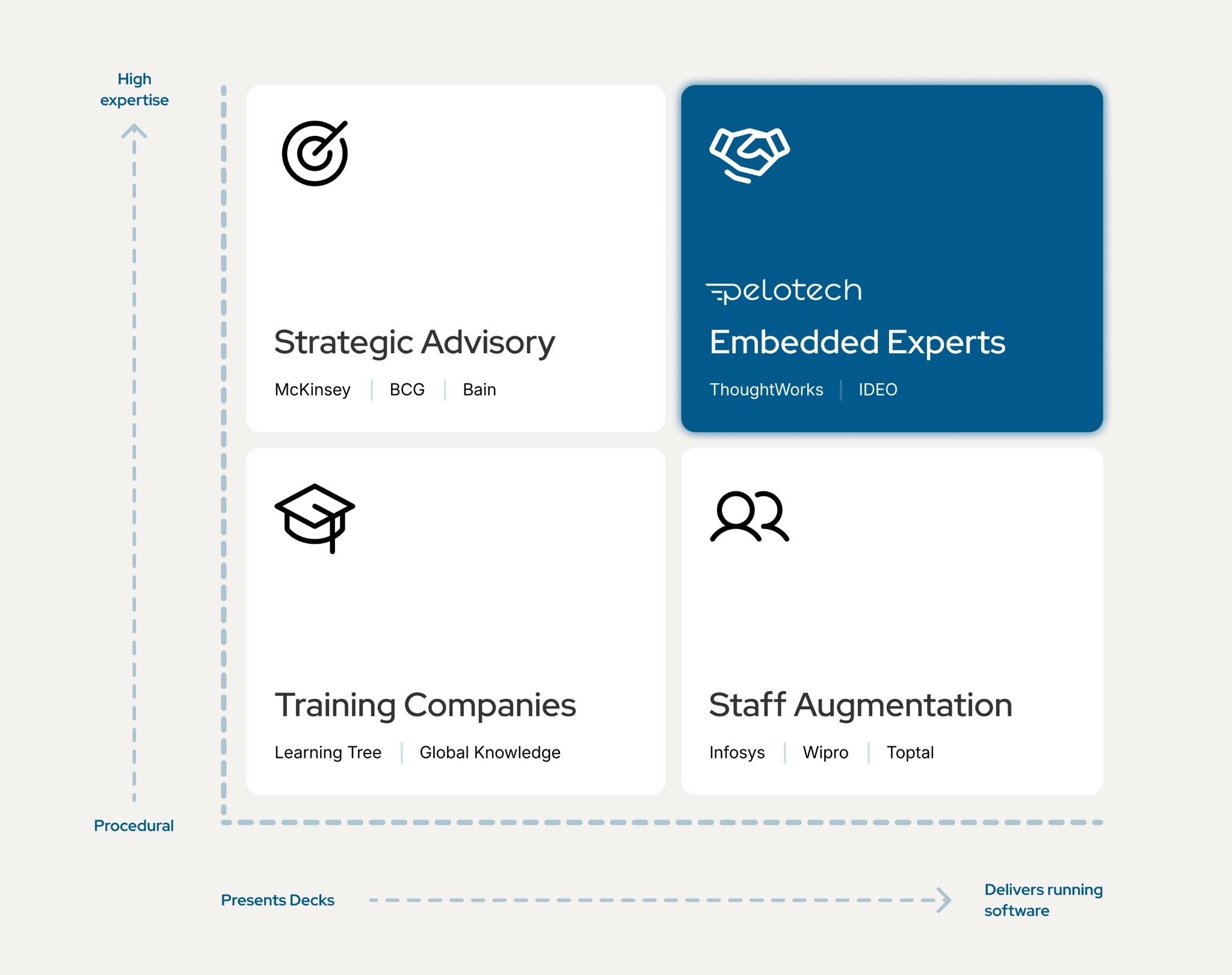
Pelotech is a US-based team of senior engineers, an AWS Advanced Tier Partner with a listing on the AWS Marketplace, and a Kubernetes Certified Service Provider (KCSP). Since 2012, we've helped mid-sized, large, and government-adjacent companies fix the infrastructure problems holding them back.
We work with companies whose engineers are capable but shouldn't be the AWS operations team. Running the environment is half the job. The other half is deciding what to simplify, automate, or remove, so each quarter there's less infrastructure to operate.
Here's what we take on:
- Ongoing AWS operations: Monitoring, patching, and tuning after go-live, by the engineers who built the environment.
- Infrastructure as code and Kubernetes: Terraform-managed environments and EKS with ArgoCD GitOps, so every change is versioned and reversible.
- Security and compliance automation: CloudTrail, Security Hub, and AWS Config wired for continuous compliance checks.
- Cost and performance optimization: Right-sizing and removing infrastructure nobody needs.
- AWS cloud migrations: Handled workload by workload.
We diagnose before we take over the queue
Usually, AWS MSPs onboard your environment as-is and start closing tickets. But we start by finding what generates the tickets, because the cheapest incident is the one the architecture no longer produces.
For UKi, that meant tracing hundreds of work stoppages to a third-party virtualization dependency and replacing it with a Kubernetes-based platform, which saved $500,000 a year. The engineer who assesses your environment is the engineer who works in it afterward.
What this looks like in practice: GovCloud with zero AWS admins
Quantum Interface (QI) is a US government contractor that builds human-machine interface software for military personnel, with an engineering team of two to three people. Its AWS setup ran in a single account, used long-lived credentials throughout, and had no automated NIST SP 800-53 reporting across GovCloud and Commercial AWS.
We rebuilt it as a Terraform-managed, multi-account architecture mirrored across both partitions. Human access runs through Microsoft Entra and AWS IAM Identity Center, and every CI/CD pipeline uses OIDC short-lived tokens. The results:
- 0 dedicated AWS administrators
- 0 long-lived credentials anywhere in the environment
- Continuous, automated NIST SP 800-53 compliance monitoring, with drift detected within hours
We still maintain the environment, so QI picks up the patterns and fixes we develop for other clients. We operate as the AWS operations function around QI's engineers.
2. Mission Cloud: Best for AWS-only managed cloud operations
Mission Cloud is an AWS Premier Tier Partner that works exclusively on AWS. CDW acquired Mission in December 2024, and it now operates as CDW's dedicated AWS practice, serving more than 500 companies.
Three of Mission's packages carry the operational work:
- Cloud Operate: 24/7 alert response from CloudOps engineers, following runbooks co-developed with your team, plus routine patching.
- Cloud Secure: A Security Operations Center (SOC) built on CrowdStrike Falcon Complete.
- Cloud Foundation: Cost visibility through Vantage, and a 5% AWS bill discount when billing moves into Mission's payer account.
A technical account manager is your primary contact. For payments platform FrontStream, Mission's monitoring, patching, and right-sizing took uptime from 99% to 99.99%.
What stands out: An AWS-only CloudOps operation with people, runbooks, and tooling already in place.
What stays with your team: Co-owning the runbooks Mission responds from, and architecture changes beyond routine operations.
Consider Mission Cloud if: You want comprehensive AWS management through an established managed-cloud operation.
May not fit if: You want a smaller senior-engineering engagement focused on bespoke infrastructure improvement.
3. nClouds: Best for cloud-native teams needing AWS + DevOps
nClouds has built on AWS since the EC2 beta and has been an audited AWS MSP, continuously recertified, since 2016. It's a Premier Tier Partner with competencies in Migration, DevOps, Security, and SaaS.
nClouds pairs AWS operations with the delivery work next to it:
- 24/7 support: Monitoring, incident management, and troubleshooting.
- DevOps and SRE: For data company Alation, nClouds moved workloads from EC2 to Amazon EKS and ran 24/7 SRE against defined SLOs.
- FinOps: Ongoing cost reporting and optimization.
At property management firm Associa, nClouds works as an extension of the in-house team. It acquired AWS partner AppEvolve in September 2026, so ask which team will staff your account.
What stands out: Managed AWS operations tied closely to CI/CD, reliability, and observability work.
What stays with your team: Product and application ownership, with nClouds working inside your delivery pipeline.
Consider nClouds if: Your operational problems extend into CI/CD, reliability, and cloud-native delivery.
May not fit if: Your primary need is traditional enterprise IT operations.
4. AllCloud: Best for AWS operations + 24/7 security monitoring

AllCloud is an AWS Premier Partner and audited managed services partner, headquartered in Denver with offices in Tel Aviv and Berlin. It primarily serves mid-sized and enterprise companies.
Its AllCloud Engage program splits ownership into two tiers:
- Essential: Ongoing AWS support, FinOps, and solutions architect advisory, while day-to-day operations stay with you.
- Professional: AllCloud takes over provisioning, health monitoring, and change, incident, and patch management.
- Managed security: As an AWS Level 1 MSSP, AllCloud provides 24/7/365 incident alerting and response using GuardDuty, Security Hub, Inspector, and Macie.
For cybersecurity company Morphisec, AllCloud moved EBS volumes from gp2 to gp3, cutting storage costs by 20%.
What stands out: Infrastructure operations and security operations under one provider.
What stays with your team: Most daily operations on Essential; application delivery decisions on Professional.
Consider AllCloud if: You want managed AWS plus substantial 24/7 security monitoring.
May not fit if: Your main requirement is hands-on cloud-native engineering.
5. Deloitte: Best for enterprise AWS operations + cybersecurity

Deloitte is an AWS Premier Tier Partner and an AWS Level 1 MSSP. Its managed AWS work sits inside its cyber practice, which has built ten managed security specializations with AWS.
Those services cover:
- Identity and access: Single sign-on, adaptive MFA, privileged access management, and access reviews.
- Infrastructure security: Vulnerability scanning, managed WAF, DDoS mitigation, and patch management.
- Threat response: 24/7/365 incident alerting and response with automated remediation.
- DevSecOps: Security automation built into delivery pipelines.
In the US, it positions cloud managed services alongside its Government & Public Services practice.
What stands out: AWS operations delivered through an enterprise cyber practice.
What stays with your team: Platform and application engineering, unless scoped into a wider Deloitte engagement.
Consider Deloitte if: Cloud operations need to integrate with wider security, governance, and enterprise risk programs.
May not fit if: You don't need a global professional-services firm around the engagement.
6. Accenture: Best for large-scale AWS transformation + operations
Accenture runs AWS work through its Accenture AWS Business Group, which covers strategy, design, planning, execution, and run. The firm holds more than 30 AWS competencies and service delivery designations, and its staff holds more than 30,000 AWS certifications.
The lifecycle it covers:
- Migration: Large estates, including SAP migrations to AWS.
- Modernization and security: Data, AI/ML, and security programs.
- Ongoing operations: Managed services that run the environment after transformation.
Del Monte, for example, used Accenture to move its IT infrastructure to the public cloud.
What stands out: One partner to carry a large organization from cloud strategy through ongoing operations.
What stays with your team: Program ownership and governance across a multi-workstream engagement.
Consider Accenture if: Managed AWS is part of a much larger enterprise transformation.
May not fit if: Your goal is removing day-to-day AWS operations from a mid-sized engineering team.
7. Rackspace Technology: Best for hybrid and multi-cloud operations
.webp)
Rackspace is an AWS Premier Tier Partner and AWS MSP with 19 AWS competencies and more than 2,700 AWS certifications. It also manages Azure, Google Cloud, and VMware private cloud.
Its AWS services cover:
- 24x7 operations: Monitoring and operational management of AWS infrastructure.
- Security: Rackspace Managed XDR and FedRAMP compliance support.
- Elastic Engineering: A pod of nine, from an engagement manager and two architects to six engineers, billed monthly with no long-term commitment.
ISG named Rackspace a Leader in AWS Managed Services for the US and Germany in 2025.
What stands out: Managed operations across AWS, other public clouds, and private infrastructure from one provider.
What stays with your team: Prioritizing the pod's work and owning cross-cloud architecture decisions.
Consider Rackspace if: You need operational support across AWS and a broader hybrid or multi-cloud estate.
May not fit if: You're AWS-only and direct access to a small senior team matters more than multi-cloud breadth.
8. TCS: Best for global enterprises standardizing cloud operations
Tata Consultancy Services (TCS) is an AWS Premier Tier Services Partner with a dedicated AWS business unit. Its 2024 strategic agreement with AWS lists AWS MSP program membership and more than 38 AWS competencies and service validations.
Its managed operations run through TCS Cloud Exponence, a multi-tenant platform that provides:
- Service management: Incident, change, and service request modules integrated with your ITSM approvals.
- Automated patching: AWS Systems Manager Patch Manager and maintenance windows across fleets.
- Governance and observability: Enforced security baselines, plus CloudWatch and CloudTrail Lake integrations.
TCS primarily serves large enterprises in banking, life sciences, travel, manufacturing, and telecom.
What stands out: Platform-led operations that standardize management across large environments.
What stays with your team: Mapping your change and approval processes onto TCS's ITSM workflows.
Consider TCS if: You need repeatable CloudOps and governance across a large global estate.
May not fit if: Your AWS environment is smaller and bespoke engineering matters more than a standardized operating model.
How to choose an AWS managed service provider
Two companies searching for an AWS MSP can need completely different relationships. Three questions separate good fits from expensive mismatches.
1. How much AWS responsibility do you want them to own?
Providers sit along a spectrum:
- Expert support: Advisory and escalation while your team runs operations, like AllCloud's Engage Essential.
- Team augmentation: Extra engineering capacity on your backlog, like Rackspace's Elastic Engineering pods.
- 24/7 operations: The provider responds to alerts and handles patching, like Mission's Cloud Operate.
- Operational ownership: The provider runs the environment, as we do for Quantum Interface.
Before the first call, list who currently handles incidents, patching, security findings, infrastructure changes, Kubernetes, cost reviews, and compliance evidence. Then ask each provider which of those they'll own.
2. Will they only maintain the environment, or improve it?
Monitoring and ticket resolution keep an environment running at its current cost and complexity. Ask what the provider will do to reduce the work: automate repetitive tasks, remove unused infrastructure, and fix architecture that causes repeat incidents.
Much of the complexity we remove was built for requirements that never arrived, such as multi-region failover for workloads that serve one region. Every extra component is something to patch, monitor, and secure.
"If it's complicated, you just can't keep all the context together. Simple systems are much easier to secure," Joachim Hill-Grannec, our co-founder, said on the DevSecOps Talks podcast. Ask each provider for an example where they deleted infrastructure.
3. What happens if you stop working together?
Check how you'd leave before you sign:
- Infrastructure as code: Your environment lives in a repository you own.
- AWS accounts and access: Accounts sit in your AWS Organization, and you control admin access.
- Tooling dependencies: Proprietary platforms you'd lose on exit, such as Mission Control, nVision, or Cloud Exponence.
- Documentation and handover: Runbooks, architecture decisions, and a defined exit process.
"If swapping a tool out would be extremely hard, that's a pretty big smell," Joachim said on the same podcast. Apply that test to the provider too.
FAQs
Conclusion
AWS managed service providers aren't interchangeable. The right fit depends on how much operational responsibility you want to hand over, what AWS expertise your team already has, and whether you need the environment maintained or continuously improved.
For mid-sized engineering organizations without dedicated AWS operations, Pelotech provides senior AWS engineers who diagnose what's driving the operational load, run the environment, and simplify it over time.
