


Engineering leaders treat quality in software delivery as something you buy with caution: slow down, add another review, and plan more before committing. Put a gate in front of the release so the last bad one never repeats.
But teams with the fastest software delivery tend to ship the highest-quality software, and the caution that promises to protect quality is usually what erodes it. For the person accountable for an engineering org, it surfaces in release frequency, in defect rates, and in how long a good idea takes to reach a customer who will pay for it.
In this, piece I name the habit that causes the slowdown, follows what it actually costs the business, and lays out what strong delivery looks like once you stop trying to engineer every mistake out of it.
Where Engineering Leaders Lose Software Delivery Speed
Typically, when a release goes badly, someone takes the blame, and the org responds by adding a step to guarantee it never happens again
When delivery falls behind, I see the same three reflexes:
- Add gates, so nothing risky gets through.
- Add process, so every decision gets reviewed.
- Add people, so there’s more capacity to push against the backlog.
Each one feels responsible on its own. And each one is reaching for the same thing: more control.
Cycle time is the symptom that gives it all away. In most orgs it’s already too long before anyone thinks to measure it, and every new control makes it longer.
Honestly, this holds way beyond engineering. Anything with a lot of gates takes too long, whether it’s how you ship code or how you make a decision. The caution that’s meant to protect quality is the same force slowing you to a crawl.
Faster Teams Produce Higher Software Delivery Quality
To see why the caution instinct is backwards, I love this story from a book called Art & Fear.
A pottery teacher splits the class in two. One half gets graded on a single pot: make one perfect piece, earn an A. The other half gets graded purely on quantity: he’d count the pots, and the quality of any single one didn’t matter.
By the end of the term, the best pots came from the group told to just make as many as they could. They’d learned by shaping clay over and over, while the other group sat around theorizing about the perfect pot.
Orgs do the paper version of this every day. They love the idea of iteration, and then they iterate on a slide instead of in production. Iterating on a piece of paper is exactly what the people chasing the perfect pot were doing. Real iteration means putting software in front of users, learning from what actually happens, and improving from there.
There’s a great study behind a book called Accelerate (something like 26,000 developers) that found the same thing in hard data: the teams that ship faster and more often produce higher-quality software. Quality is an output of iteration, which means anything that slows iteration down is buying you lower quality.
How Added Process and Headcount Stall Software Delivery Performance

Each gate looks responsible on its own. Stack them together and they compound into delay, and slower iteration makes the product worse for the customer who’s waiting on it. So the first cost of the caution reflex is the very thing it was supposed to prevent: lower quality, just arriving later.
Adding people rarely helps either. Throwing bodies at a delivery problem doesn’t move time-to-value. Nine engineers can’t ship in a month what one engineer ships in nine. And a new developer who needs six months to deliver anything useful isn’t going to change a single customer outcome for six months, however many of them you hire.
The lever that actually matters is how fast a new developer can deliver value, and how short the path is from a change to production.
This is usually the state an org is in when we get the call. They describe it the same way every time: they’re underwater, drowning, and the response is to tie on more weights and wonder why they keep sinking.
Every step they add to climb out just pushes them deeper. And the gap is rarely raw engineering capacity. More often it’s support load swamping the team, technical debt they took on to hit some old deadline, or engineering hedging between two competing visions nobody’s actually chosen between.
None of that gets fixed with more process or more headcount, which is exactly why doing more of the same makes it worse, especially when AI gets in the loop.
AI Overreliance Becomes Technical Debt
The same problem shows up the moment AI enters the workflow. The way I think about coding assistants is hand tools versus power tools. Power tools make you faster. But speed was never the hard part of building the right thing. Hand someone a pile of power tools and tell them to build a house, and the tools won’t supply the judgment about what to build or why.
Teams that already ship in short, well-guardrailed cycles tend to absorb these tools really well. But for gate-heavy teams with slow feedback loops, the same tools just turn into accelerated technical debt because now AI lets them build the wrong thing faster than ever.
The expensive failure mode here is comprehension debt. You ship code nobody on the team actually understands, and the engineers who lean on the tool for everything stop building the expertise that would let them fix it later. I think every task an engineer finishes should leave them with a better grasp of the system, the customer problem, and the business behind it.
Outsource that learning entirely and your codebase and your team both get more fragile, which is the opposite of what the speed was supposed to buy you. You are just creating more problems.
The Cost of Mistakes in Software Delivery
So what replaces the reflex? Start by changing what you’re careful about. When you try to eliminate every mistake, you raise the cost of each one and stall the whole system because you’ve set the penalty for being wrong impossibly high, and the planning never ends.
Lower the cost of a mistake instead with small batches and low-risk validation before anything ships widely. Cheap recovery when something does go sideways. Put those in place and a team can afford to be wrong, learn from it, and keep moving. The goal is to make mistakes cheap enough that they stop being scary.
There’s also a story I like about Amazon testing the “you might also like” feature on a slice of traffic before rolling it out to everyone. The team that owned the checkout flow had a reasonable fear that an extra step would push up cart abandonment.
So instead of arguing about it, they put it in front of a fraction of customers and watched. Abandonment ticked up a little, but average cart size went through the roof. They only got that lesson because the cost of being wrong had been kept small.
Matching Your Controls to Software Delivery Risk
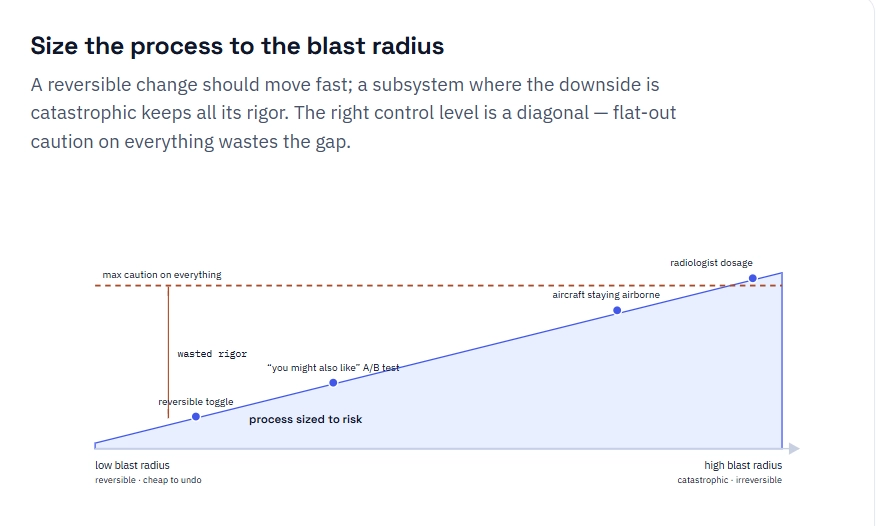
Moving faster doesn’t mean treating every change the same. The discipline is to match your controls to the blast radius. A reversible, low-stakes change should move fast. A subsystem where the downside is catastrophic keeps every bit of its rigor.
Nobody wants their airplane running a live experiment on whether it stays in the air, and nobody wants their radiologist improvising on dosage. Measure the real consequence of a given mistake and size the process to it, instead of applying maximum caution to everything because a few things genuinely earn it.
And here’s the part people miss: what earns customer trust when something does slip is almost never a flawless record. It’s how you handle the problem when one shows up. Tell customers what happened, own it, fix it together as partners, and you’ll build more goodwill than a year of uneventful releases ever would have.
The way I see it is that it’s more of a culture issue.
Strong Software Delivery Is a Culture Problem
None of this sticks as a process you install. If a team doesn’t actually buy that rapid iteration produces higher quality, it’ll rebuild the old gates inside whatever new process you hand it. You can watch this happen with Agile and the heavyweight frameworks turn iteration right back into the gatekeeping it was meant to replace. Teams adopt all the ceremonies and miss the principles that made them work in the first place.
There’s a lesson in a book called Toyota Kata that stuck with me. A consultant kept asking Toyota’s leaders whether some particular procedure was being done correctly, and they kept telling him the procedure was never the point, but the principle behind it was. Copy the ritual without the principle and you get the paperwork without the result.
This is why I think the difference between management and leadership matters way more than most orgs treat it. Management keeps individuals unblocked and moving through their work. Leadership sets a direction clear enough that anyone in the company can point to where it’s going. And that matters because every engineer makes small decisions all day that either compound toward that direction or away from it.
Should this test suite run another ten minutes on every commit, or should the team find a way to keep the feedback loop fast? Add a gate, or find a quicker route? Multiply those micro-decisions across a team and a year and that’s your delivery culture, and without a clear direction, they just default to whatever got decided in the last hallway conversation.
This brings us to the fact that speed shouldn’t contradict quality.
Speed and Quality in Software Delivery Are the Same Goal
Speed and quality are the same project, done with judgment. Teams that treat them as a tradeoff slow themselves down on both, and the caution that feels so safe is usually what makes delivery slow and brittle. The question for a leader isn’t speed vs. quality. It’s where the cost of a mistake is genuinely too high, and how to lower it everywhere else so your team can learn at speed.
When an engineering org is underwater on its own promises and adding process has stopped helping, the constraint almost always lives in the system.
That’s the problem we’re built to diagnose at Pelotech. We start by asking whether the stated problem is even the real one, then we go after cycle time, gates, and feedback loops at the root. Sometimes the honest answer is to rip out a tool, buy instead of build, or just do less.
Dropping Provisioning from four weeks to twenty minutes for UKI
UKI’s OD360 platform had grown into 30–40 interdependent services with no self-healing. When one went down, you needed a “decoder ring” to work out the restart order. Standing up a new environment took three or four people the better part of a month, and production shipped maybe once every six months.
We didn’t fix that by adding people or processes. We refactored the application to cut the interdependencies, moved it onto EKS with GitOps, and let the system start healing itself:
- Provisioning went from four weeks to twenty minutes.
- Deployments went from twice a year to daily and automated.
- Cost per environment dropped more than 80%.
The faster, simpler system wasn’t a tradeoff against quality.
Check out the full case study here: UKI OD360 GovCloud case study.
If your delivery is stuck and you can’t tell whether the problem is the engineering or everything around it, that’s worth a conversation.
